The AARC TREE project held its final event on 10 February 2026, marking the completion of its work ahead of the project’s conclusion at the end of February 2026.
Over the past two years, the project has revised and enhanced the AARC Blueprint Architecture (BPA) released in 2019 and its interoperability framework (policy and technical guidelines) to reflect evolving technical practices and community needs. The AARC BPA 2025 introduces clearer terminology and takes important steps toward future-proofing the architecture. The most significant change is the shift towards Identity Management and Collaboration Management capabilities, which decouples user identification from dynamic collaboration membership entitlements and structurally aligns the architecture with the issuer roles required by emerging wallet-based paradigms (such as the EUDI Wallet). Christos and Nicolas say that the aim is to bring the users more in the centre, whilst remaining backward compatible. There are 10 main changes, can you spot them? You can check the final event slide deck for more details and very soon the final version of the AARC BPA document.
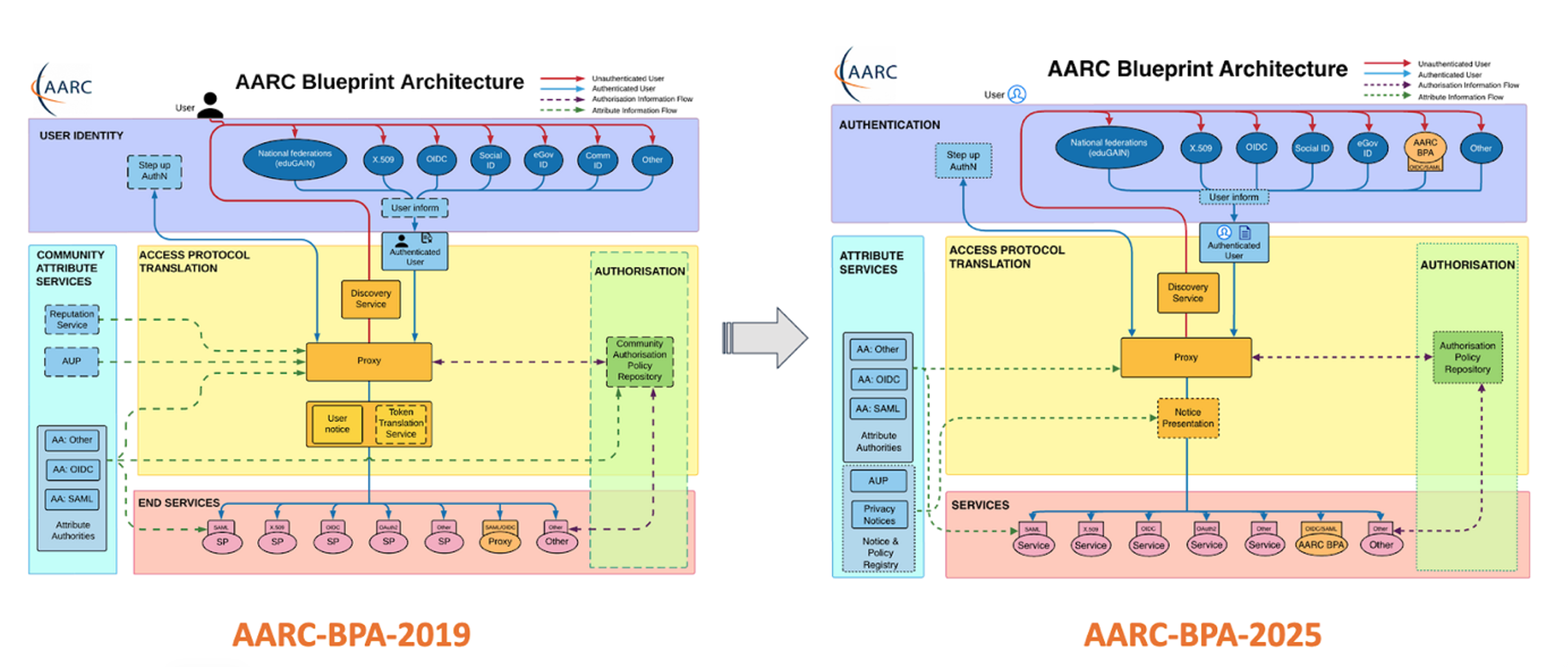
The AARC BPA to date underpins the Authentication and Authorisation Infrastructures (AAIs) used in the research and education sector.
The revision encompassed also the associated Policy Development Kit released in 2019, which was subject to updates over time, but was deemed still too complex. The PDK offers a clear framework for federated security policies, particularly aimed at small communities that may not have sufficient in-house expertise. The AARC policy team has now compressed all the work in a clear sequence of steps and related policy documents.
During the meeting, the AARC TREE Compendium was officially launched, following a series of presentations at various events, most recently at the FIM4R meeting hosted during TechEx2025.
The Compendium, now renamed the AARC Handbook, is intended as an introductory guide to implementing federated identity management for research collaborations, based on the AARC Blueprint Architecture (BPA). The Handbook aims to reduce start-up time for research collaborations and facilitate interoperability in the coming years by providing concise guidance, practical recommendations, and ready-to-use implementation tools.
The final event has highlighted these achievements, reflected on lessons learned, and discussed how the updated AARC outputs can continue to support interoperable and sustainable AAI solutions beyond the lifetime of the project.